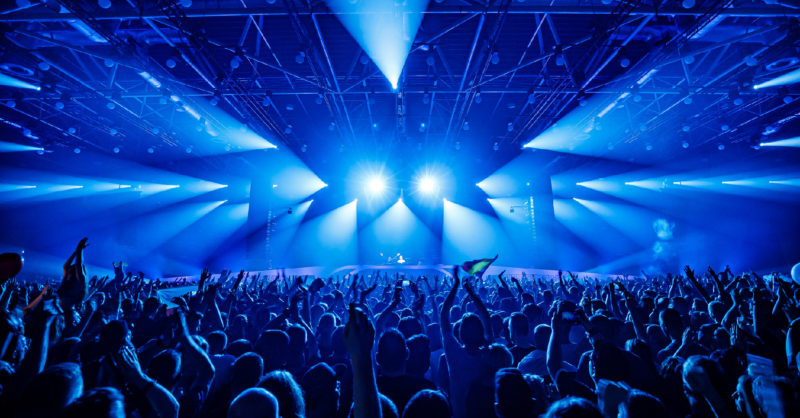
Trance began in Frankfurt around 1990, hit its commercial peak between about 1998 and 2002, became a Dutch-led arena sound in the 2000s, lost the main stage to EDM in the 2010s, and has been pulled back into clubs in the 2020s by DJs who grew up on its CDs.
Around 1990: Frankfurt and the first records
The KLF released “What Time Is Love? (Pure Trance)” in the UK in 1988. In 1990 the Italian-Belgian project Age of Love put out “The Age of Love” on a small Belgian label, and the German duo Jam & Spoon’s 1992 remix turned it into one of the first widely known trance records.
The centre of gravity was Frankfurt, where the sound grew out of the city’s techno and EBM scene. Two clubs mattered most: Dorian Gray, which sat inside Terminal 1 of Frankfurt Airport from 1978 to 2000, and Omen, which Sven Väth co-opened in 1988. Rolf Ellmer and DJ Dag Lerner formed Dance 2 Trance there in 1990 and released “We Came in Peace” the same year. Lerner has said he was the first to call the music trance.
Väth co-founded the Eye Q label in 1991 and Harthouse in 1992, and released his album Accident in Paradise on Eye Q in 1992. Energy 52’s “Café del Mar” followed on the same label in 1993. In Berlin, the MFS label signed Cosmic Baby and Paul van Dyk, whose 1994 album 45 RPM included the first version of “For an Angel”.
The mid-1990s: Goa, Britain and “Children”
A parallel scene formed in Goa, India, where beach parties dated back to the hippie years. Goa trance took shape in the early 1990s and had its best years between 1994 and 1997. Paul Oakenfold’s Goa Mix, broadcast as a BBC Radio 1 Essential Mix on 18 December 1994, brought it to a mainstream British audience, and Hallucinogen’s album Twisted followed in October 1995. By the late 1990s it was evolving into psytrance.
In Britain, Simon Berry launched Platipus Records in 1993, and in Belgium the Bonzai label pushed a harder version of the sound. In Italy, Robert Miles wrote “Children” partly as a calming record to end his sets, in response to a run of fatal car crashes involving clubbers driving home. It went unnoticed on its first Italian release in January 1995, then reached number one in more than twelve countries and became Europe’s most successful single of 1996.
1997 to 2002: the commercial peak
Roland’s JP-8000 synthesizer arrived in the mid-1990s with a waveform called the supersaw, and that wide, bright lead became the sound of the period. Gatecrasher settled permanently at the Republic in Sheffield in 1997 and was central to trance’s rise in Britain. In the Netherlands, Tiësto and Arny Bink founded Black Hole Recordings the same year.
Then the records: Paul van Dyk’s reworked “For an Angel” in 1998, and in 1999 Ferry Corsten’s “Out of the Blue” as System F, Rank 1’s “Airwave”, and Gouryella, a Corsten and Tiësto collaboration. In July 1999, ATB’s “9 PM (Till I Come)” became the first trance record to top the UK singles chart. The Dutch promoter ID&T had held the first Trance Energy event that April, and on 1 June 2001 Armin van Buuren broadcast the first episode of A State of Trance.
1998 is also the year I started making loops in FruityLoops in college, a story I’ve told in how I found my sound.
The 2000s: the Dutch arena years
The centre moved to the Netherlands and the rooms got bigger. Tiësto topped the DJ Mag Top 100 in 2002, 2003 and 2004, played a solo concert to about 25,000 people at the GelreDome in Arnhem in May 2003, and on 13 August 2004 became the first DJ to play live at an Olympic Games, during the Parade of Nations at the Athens opening ceremony. His version of “Adagio for Strings” came out in January 2005.
Armin van Buuren co-founded Armada Music in 2003 and held the DJ Mag number one spot from 2007 to 2010 and again in 2012. Above & Beyond started the radio show Trance Around the World in 2004. Meanwhile the harder, techno-influenced tech trance of producers like Marco V and Bryan Kearney had become the most widespread form of the genre by the middle of the decade.
Tiësto’s 2009 album Kaleidoscope moved away from trance, and he left Black Hole for his own label soon after.
The 2010s: off the main stage
As EDM’s sound changed through the 2010s, festival main stages went to big room and electro house. Trance Energy was renamed Energy in 2011, opened to other genres, and was gone after 2013.
The core audience stayed, though. Armin van Buuren’s “This Is What It Feels Like” (2013) earned a Grammy nomination for Best Dance Recording. Above & Beyond replaced their radio show with Group Therapy in 2012 and played its hundredth episode at Madison Square Garden in October 2014. Psytrance reached a festival audience when Vini Vici teamed up with van Buuren and Hilight Tribe on “Great Spirit” in 2016. And from around 2017, underground techno DJs such as Nina Kraviz began working trance records into their sets.
The 2020s: the revival
A State of Trance reached its 1,000th episode in January 2021. The same year, Charlotte de Witte and Enrico Sangiuliano remixed “The Age of Love”, putting a 1990 record in front of a techno crowd. In February 2023, Philip Sherburne argued in Pitchfork that trance was back and that this time nobody was joking (Longreads has a summary), crediting younger DJs who came to it from outside the scene.
A State of Trance moved its festival to Rotterdam Ahoy in 2024 and marked 25 years there in February 2026. In 2025 Tiësto announced a live show called Prismatic that brought trance back into his sets. Whether it lasts is a separate question, which I take on in is trance music making a comeback.